Free Shipping On Orders over $75
November 18, 2026 8 min read
Somebody at your house has just asked how big a T. rex tooth was, and "really big" didn't satisfy them. Here is the full answer. T. rex teeth were the largest of any meat-eating dinosaur we know well. The biggest ones were about a foot long once you count the root. A Tyrannosaurus had roughly 50 to 60 of them at any one time, and it never stopped growing new ones. They weren't built like steak knives. They were thick, rounded spikes, made for biting through bone instead of slicing flesh.
Below: the numbers, why the teeth were shaped that way, what fossils show they were used for, a comparison with other animals, quick facts for kids, and what to check before you buy a fossil tooth.
| Question | Short answer |
|---|---|
| How many teeth? | About 50–60 at once; the exact count varies from skull to skull |
| Biggest tooth? | About 12 inches (30 cm) including the root |
| Shape? | Thick and rounded, nicknamed "killer bananas", with serrated edges |
| Did they grow back? | Yes, all its life; a new tooth grew in beneath each old one |
| Could it bite through bone? | Yes. Fossil bite marks and fossil dung both show it |
| Did they show when its mouth was shut? | Probably not; a 2023 study argues for lips |
A grown T. rex had somewhere between 50 and 60 teeth in its mouth at once. You won't find one exact number, for two reasons. Different skulls preserve different counts, and at any moment some sockets held a tooth that had just fallen out or one that was still coming in.
They weren't all the same:
The largest T. rex tooth found so far is about 12 inches (30 cm) long. Most of that length is root, not crown. T. rex had very long roots set deep in the jaw, which anchored each tooth against the force of a bite. The crown, the part that stuck out of the gums, was smaller, but the biggest crowns were still about the size of a banana. That's where the "killer bananas" nickname comes from.
For scale: an adult human canine is about an inch long, root included. Lay one next to the biggest T. rex tooth and the dinosaur's is roughly twelve times longer and many times thicker.
Most meat-eating dinosaurs, Allosaurus for example, had teeth like flattened blades: thin from side to side and good for slicing. T. rex teeth were much thicker from side to side, close to round in cross-section at the base. Thickness gives strength. A thin blade snaps when it hits bone; a thick spike punches through.
Three details made them work:
We don't have to guess. Several fossils show T. rex teeth at work:
The bite behind those teeth was enormous. A widely cited 2017 study estimated it at about 35,000 newtons at the back teeth, roughly 7,800 pounds of force. Other estimates run higher. T. rex seems to have fed by "puncture and pull": bite down hard, then rip backward, letting the serrations do the tearing. For what it was actually eating, see our guide to what T. rex really ate.
Yes, all the time. Like crocodiles and sharks, and unlike us, T. rex replaced its teeth throughout its life. A new tooth formed in the jaw beneath each working tooth. When the old one wore down or broke off, the replacement moved up into place.
It wasn't fast by dinosaur standards. One study counted the daily growth lines inside fossil teeth, which work like tree rings. It estimated that a T. rex tooth took around two years to be replaced. Some long-necked plant-eaters were far quicker. Nigersaurus, with about 500 teeth, seems to have replaced each one every couple of weeks.
All that replacing is why shed T. rex teeth are among the most common tyrannosaur fossils. Each animal dropped many teeth over its life, and every one of them could end up buried.
The movie T. rex shows off its teeth with its mouth shut. The real one probably didn't. A 2023 study in Science compared dinosaur skulls and tooth enamel with living reptiles. It concluded that T. rex and its relatives likely had lip-like tissue covering their teeth when the mouth was closed, much as lizards do. Enamel dries out and wears quickly if it's always exposed, and T. rex enamel doesn't show that kind of wear.
Not every paleontologist agrees, and some think crocodile-style exposed teeth fit the evidence too. But the "lips" view has a lot of support right now. If you draw a resting T. rex with its teeth hidden, you're on solid ground.
| Animal | Teeth | Shape | Used for |
|---|---|---|---|
| Tyrannosaurus rex | ~50–60 | Thick, rounded, serrated | Biting through bone |
| Allosaurus | Dozens | Thin, flat, serrated blades | Slicing flesh |
| Spinosaurus | Dozens | Straight cones, little or no serration | Gripping slippery fish |
| Triceratops | Hundreds (in stacked "dental batteries") | Packed together into a cutting edge | Shearing tough plants |
| Edmontosaurus | Hundreds (dental batteries) | Packed together into a grinding surface | Grinding plants |
| Nigersaurus | ~500 | Small, in a wide straight row | Cropping low plants |
| Great white shark | ~300, in rows | Flat, triangular, serrated | Slicing chunks of flesh |
| Adult human | 32 | Mixed | Everything |
So T. rex didn't have the most teeth. The plant-eaters beat it easily. What it had were the biggest, toughest teeth of any land predator we know.
Ten quick ones for the car, the classroom or bedtime:
Got a fact-hungry kid? Our dinosaur trivia post has 80 questions with answers, sorted from easy to hard.
Shed T. rex teeth are sold legally in the US. Most come from rock layers in Montana, the Dakotas and Wyoming, such as the Hell Creek and Lance formations. That's what the shops at the top of search results are selling. We don't sell fossils or casts, but if you're thinking of buying, here's what to ask first:
If what you want is the look of a T. rex skull and its teeth, without the authentication headache, that's the part we can help with.
Our designs are drawn from T. rex skulls and skeletons:
How many teeth did a T. rex have? About 50 to 60 at any one time. The count varies between skulls, and some sockets were always between teeth because T. rex replaced them throughout its life.
How big was the biggest T. rex tooth? About 12 inches (30 cm) including the root. The visible crown was shorter, but the largest were still banana-sized.
Were T. rex teeth sharp? They had sharp tips and serrated edges, but they weren't thin and razor-like. They were thick and strong, built to punch through bone rather than slice.
Could T. rex crush bone? Yes. Bite marks deep in Triceratops bone, and a fossil dropping full of bone fragments, both show it did. Estimates put its bite force at around 35,000 newtons or more.
Did T. rex lose its teeth? Constantly, and that was normal. A replacement grew in beneath each tooth, taking about two years. That's why shed teeth are some of the most common T. rex fossils.
Did T. rex have lips? Probably. A 2023 study argues its teeth were covered by lip-like tissue when its mouth was closed, though not every scientist agrees yet.
Can you buy a real T. rex tooth? Yes. In the US, shed teeth collected legally on private land are sold by fossil dealers. Ask for the locality, the formation, how much has been restored, and how the tooth was identified.
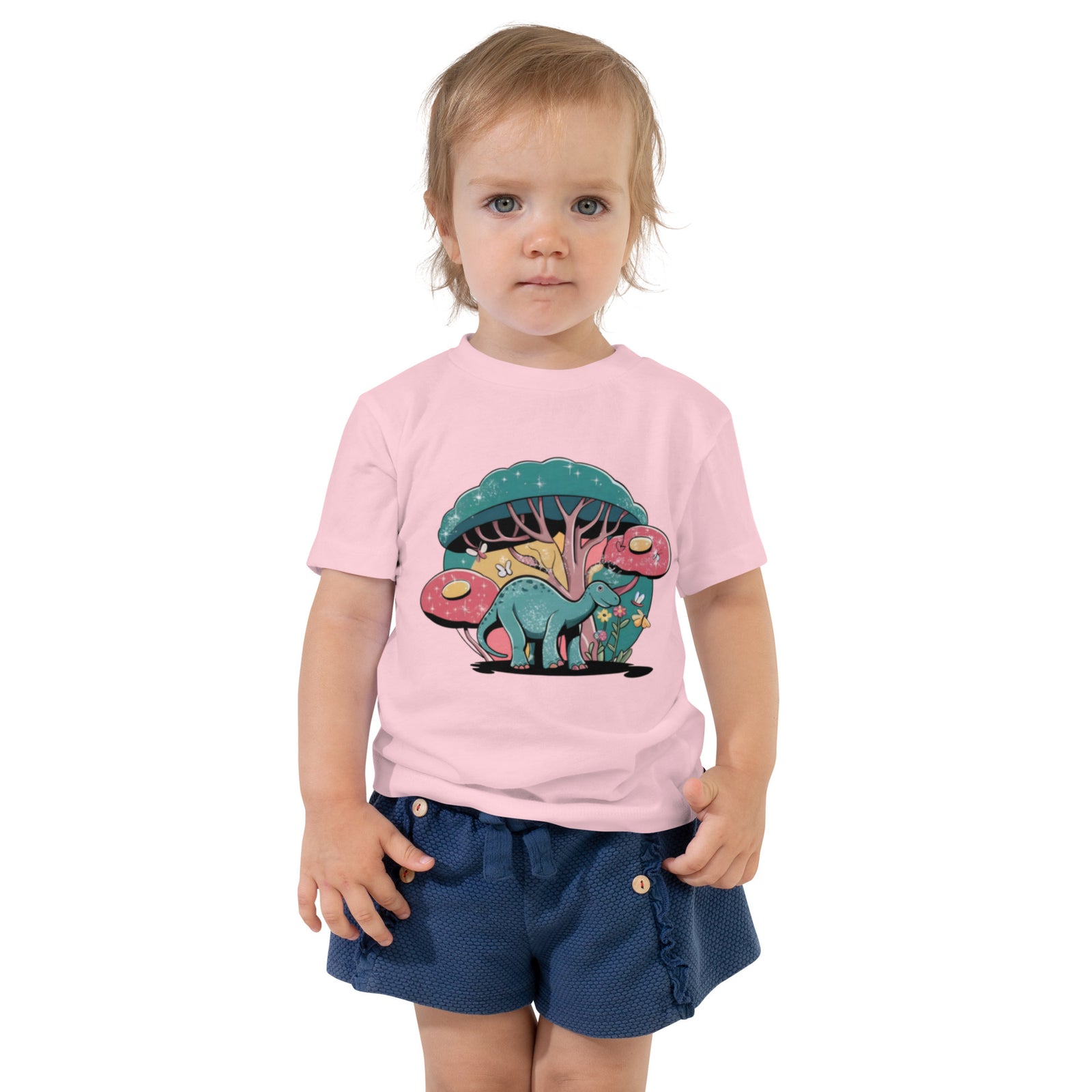
For someone who's now officially a T. rex tooth expert: start with the Fossil Hunter T-shirt, then browse every dinosaur shirt we make.
Comments will be approved before showing up.